System thesis
Case study
ChatWithWiki AzureML RAG Demo
Prompt Flow RAG demo showing retrieval, Jinja prompt construction, cloud workflow nodes, and answer review over public content.
Primary evidence: Azure ML Prompt Flow
At a glance
- Source
- Public wiki-style content
- Workflow
- Retriever, Prompt Flow, Jinja template, LLM call
- Review
- Grounded answer artifact
Cloud contextAzure ML Prompt Flow
Prompt layerJinja templates
Patternretrieval + generation + review
System problem
Why this system exists.
RAG demos are only useful when retrieval, prompt construction, and execution context are clear.
Implementation surface
What was built.
- Prompt Flow RAG example.
- Jinja templates and Python assets.
- Cloud-oriented RAG framing.
Architecture
A system map for the project.
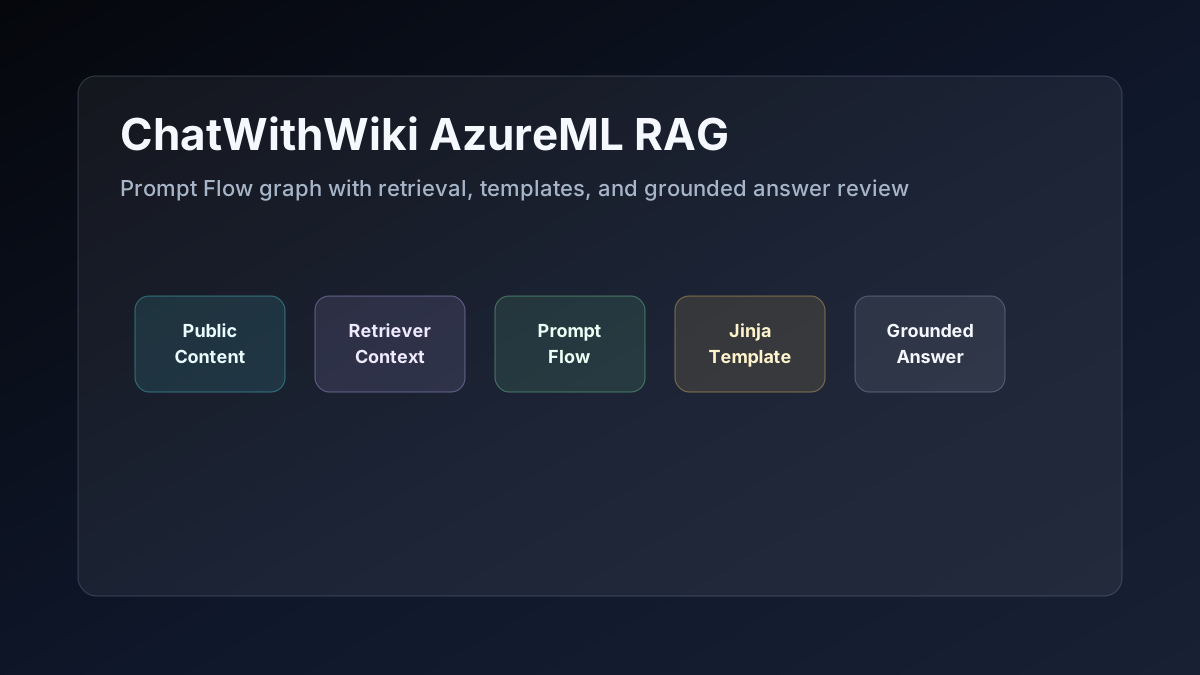
Public wiki content -> retrieval step -> prompt-flow graph -> Jinja prompt template -> LLM call -> grounded answer artifact -> evaluation/review notes.
A cloud RAG workflow that separates public content, retrieval, prompt templating, LLM generation, and answer review.
Source
public wiki contentquestionretrieval target
Retrieval
context passagesrankinggrounding
Prompt Flow
Jinja templateworkflow nodesLLM call
Review
answer artifactsource checkquality notes
How it works
Input, transformation, model or agent logic, and reviewable output.
Public content
The demo avoids private knowledge bases and keeps the source context safe for portfolio use.
Retrieval
Relevant passages are selected before prompt assembly.
Prompt Flow graph
Workflow nodes make the RAG pipeline visible rather than notebook-only.
Review
Generated answers are treated as artifacts to inspect against retrieved context.
Evidence
Screenshots, responses, diagrams, tests, and model tables from the source repos.
Artifacts are included only where the public repo has enough context to show them safely.
Prompt-flow graph
Public content -> retriever -> Prompt Flow -> Jinja template -> LLM call -> grounded answer artifact -> review.
Engineering Decisions
Cloud RAG counterpart
This complements the local document AI repo by showing an Azure ML workflow path.
Template discipline
Jinja prompt templates keep the prompt layer explicit.
Cloud RAG counterpart
The project complements the local document AI repo by showing an Azure ML workflow path.
Validation / reliability
How the system is made reviewable.
- Public metadata identifies Azure ML, Jinja, Python, Prompt Flow, and RAG focus.
- Quality depends on retrieval setup and review.
- Azure ML Prompt Flow target.
- Python and Jinja assets.
- Supporting RAG example.
Limits / responsible use
Public-content RAG demo only. Do not point it at private documents or confidential knowledge bases without controls.
- Public-content retrieval, Jinja templates, Prompt Flow nodes, and answer review are separated.
- The demo is useful as cloud RAG workflow evidence, not as a private knowledge-base deployment.
- Source grounding and review remain required before relying on generated answers.
Repository
Open the source repo and inspect the implementation boundary.
All public examples are synthetic, sanitized, historical, or research/demo implementations. No PHI, PII, employer-confidential data, proprietary claims data, private keys, production credentials, or sensitive datasets are included.